摘要:这3名患者在取得稳定的分子学缓解之后(融合基因转阴PCRU)停用达沙替尼。1名患者复发,另外两名患者在1年后仍保持了PCRU。以前说过,达沙替尼确实可以提高免疫力,希望今后能获得更多的相关研究报告。' m! O# E" ]0 I- h
关于这个研究值得注意的是,这三名患者都是服用格列卫失败后转用达沙替尼的,也即他们对格列卫是耐药的。这与法国的格列卫停药研究又有所不同,那个研究中的患者都是对格列卫反应良好的。希望医生们能扩大研究长期观察,看看停用达沙替尼是否能持久不复发。( M0 T' I( d1 L0 w+ d8 X0 D
8 k+ F6 j9 C6 l" }3 ?0 n作者:来自澳大利亚
6 x$ L+ U0 E* x6 K+ ] M来源:Haematologica. 2011.8.9.
1 X+ X5 \, G3 n" FDear Group,
6 T# V- R; o: P; w9 C2 M. D
- J* I# O/ V! JSome of you are on Dasatinib (Sprycel) and we wish to give news on all CML E1 a! p1 p7 I# N' P9 i% V2 W' j
therapies. Here is a report from Australia on 3 patients who went off Sprycel$ v/ k' Y3 ~; C
after stable molecular response (PCRU). 1 patient relapsed but 2/3 patients6 |4 ^# S$ E. W
remain in stable PCRU at the 1 year mark. Some of you may remember that Sprycel! s9 x, M; U3 a: V
does spike up the immune system so I hope more reports come out on this issue./ J0 U$ L0 N* Z
2 ?: y4 C: \3 U* s- @
The remarkable news about Sprycel cessation is that all 3 patients had failed
% `: D, ?% F9 @5 QGleevec and Sprycel was their second TKI so they had resistant disease. This is
' S3 c0 S" z9 H( @" o! Adifferent from the stopping Gleevec trial in France which only targets patients# ^3 M1 {% l9 r0 d
who have done well on Gleevec.5 u0 E6 s6 R7 r; V
; P2 g# c0 ?1 w/ B7 X! y5 [, d( Y$ pHopefully, the doctors will report on a larger study and long-term to see if the
* o ]2 j7 A1 O: N! X! T4 uresponse off Sprycel is sustained.
/ f9 u, k! C9 U7 [% B8 }
m3 G+ `" c) c0 N5 K5 \ j! m/ k$ lBest Wishes," g/ l2 h* R& R& @( n
Anjana
( E2 @& |0 }5 ^& w! j
9 N" Q! t* u. V+ \& B* [/ o
4 M0 d0 _/ |( S; U1 M% d
: {" g" ]/ K) a& a2 JHaematologica. 2011 Aug 9. [Epub ahead of print]
% v# Z0 t& a3 C$ T4 J- CDurable complete molecular remission of chronic myeloid leukemia following
# W$ x/ I3 b2 Tdasatinib cessation, despite adverse disease features.2 S) q: a8 w& \" q: c, _
Ross DM, Bartley PA, Goyne J, Morley AA, Seymour JF, Grigg AP.
8 m" J d8 \: k0 xSource
6 p: V% C6 ]7 W6 ? s4 J/ x5 B( bAdelaide, Australia;; i6 w) i& x p: B2 e7 F
R: f1 h. R7 L& U1 m8 \( {7 LAbstract0 _$ ~0 I4 U, g- K5 t7 h0 b
Patients with chronic myeloid leukemia, treated with imatinib, who have a, ^% c+ H0 I. c- g" H
durable complete molecular response might remain in CMR after stopping
( L z7 Z" u, q3 R/ } Ktreatment. Previous reports of patients stopping treatment in complete molecular2 ^$ E. l: l- b$ T! S, g* L
response have included only patients with a good response to imatinib. We/ \2 L I8 B2 Y: [' o# r
describe three patients with stable complete molecular response on dasatinib J: D$ ^9 w0 U2 F$ Q0 `" a0 M: f
treatment following imatinib failure. Two of the three patients remain in
" z# a2 N% G. ~, Y/ j1 u6 C Jcomplete molecular response more than 12 months after stopping dasatinib. In1 [ u6 d6 G* m; a# J& Y. ^$ n
these two patients we used highly sensitive patient-specific BCR-ABL1 DNA PCR to
; b8 H7 M6 n0 ?" a, ]/ u8 [/ {show that the leukemic clone remains detectable, as we have previously shown in
$ {8 e! Z- ~$ c6 b% G5 U# Limatinib-treated patients. Dasatinib-associated immunological phenomena, such as' N9 C. F; j' E# T0 N& Q
the emergence of clonal T cell populations, were observed both in one patient2 }, p. ^/ W9 Y! q8 w1 ^
who relapsed and in one patient in remission. Our results suggest that the6 r8 @: y7 e. r5 T7 q0 L
characteristics of complete molecular response on dasatinib treatment may be
# B% B& r. S# b7 K& s+ @$ `3 Osimilar to that achieved with imatinib, at least in patients with adverse, { C# B) h( v
disease features.4 |0 K7 w3 C8 {: i, P! f! V
|
 权威开讲!仲佳教授详解小细胞肺癌治
作者:雨过天晴在肺癌家族中,小细胞肺癌虽仅占15%-20%的比例,却以“恶性程度高、进
权威开讲!仲佳教授详解小细胞肺癌治
作者:雨过天晴在肺癌家族中,小细胞肺癌虽仅占15%-20%的比例,却以“恶性程度高、进
 重磅好消息!这三款肺癌靶向药进医保
12月7日,国家医保局公布最新医保目录,三款肺癌靶向药——氟泽雷塞、他雷替尼、塞普
重磅好消息!这三款肺癌靶向药进医保
12月7日,国家医保局公布最新医保目录,三款肺癌靶向药——氟泽雷塞、他雷替尼、塞普
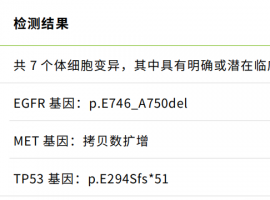 EGFR19+C797S和MET扩增+1230C,奥西
250123
病人是我妈妈,43年8月的,81周岁。
19年10月28日确诊,肺腺癌晚期,右上肺
EGFR19+C797S和MET扩增+1230C,奥西
250123
病人是我妈妈,43年8月的,81周岁。
19年10月28日确诊,肺腺癌晚期,右上肺
 父亲确诊“癌王”生命危在旦夕,医护
讲述者:吉吉整理者:pear
一年前,父亲被确诊为胰腺癌伴肝转移,那一刻,我的人生仿
父亲确诊“癌王”生命危在旦夕,医护
讲述者:吉吉整理者:pear
一年前,父亲被确诊为胰腺癌伴肝转移,那一刻,我的人生仿
 三代药泰瑞沙五年骨转,请教后续方案
17年右锁骨异常,穿刺确诊肺CA,基因检测19突变,无其他转移。服用易瑞沙,至2019肺部
三代药泰瑞沙五年骨转,请教后续方案
17年右锁骨异常,穿刺确诊肺CA,基因检测19突变,无其他转移。服用易瑞沙,至2019肺部





 显身卡
显身卡